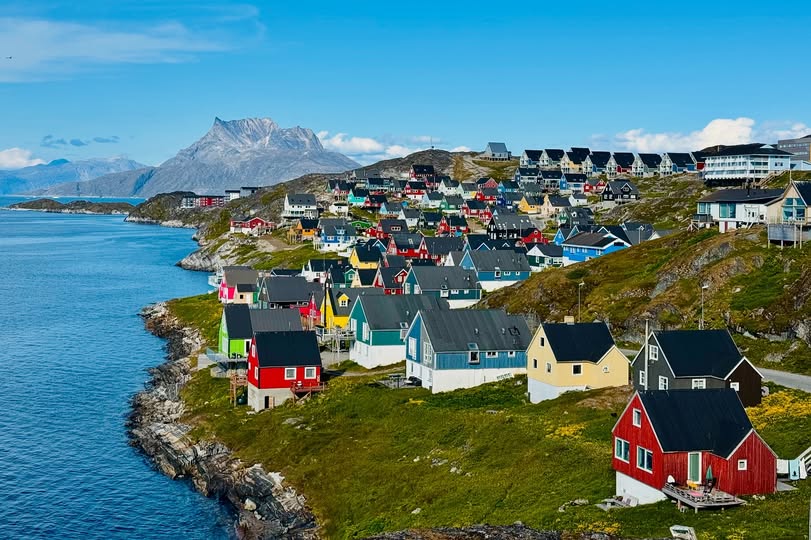
Greenland at a Glance
Greenland—Kalaallit Nunaat, “land of the people”—is the world’s largest island, culturally Arctic and politically tied to Denmark.
Greenland is the world’s largest island, home to about 56,000 people, mostly Greenlandic Inuit, with a history that mixes Inuit settlement, Norse contact, and long ties to Denmark; today it’s an autonomous territory with growing cultural revival and debates over independence.
Quick facts
- Location: Arctic island between the Atlantic and Arctic Oceans.
- Population: ~56,583 (2022) and majority Inuit.
- Official ties: Autonomous territory within the Danish Realm.
- Main language: Greenlandic (Kalaallisut); Danish and English also used.
- Economy: fishing, public sector, and growing interest in mining and tourism.
History
Greenland was first settled by ancestors of today’s Inuit; Norse settlers led by Erik the Red arrived around 982 CE, establishing farms and short-lived colonies while Inuit communities continued to thrive and adapt to Arctic conditions
- Greenland was originally settled by ancestors of today’s Inuit, who still identify the island as Kalaallit Nunaat.
- Norse explorer Erik the Red arrived in 982 CE and named it “Greenland” to attract settlers.
- Over centuries, Inuit and Norse histories intertwined, though Norse settlements eventually disappeared.
- Greenland later became part of the Danish realm and today is an autonomous territory with increasing self-governance
- Greenland later became part of the Danish realm and today is an autonomous territory with increasing self-governance

Population
Population and society
The island’s population is small and concentrated along the ice‑free west coast; Greenlandic Inuit make up roughly 85–90% of residents, with a diaspora in Denmark and elsewhere. Urban centers like Nuuk are cultural and administrative hubs.
- About 56,583 people live in Greenland (2022 estimate).
- 85–90% are Greenlandic Inuit (Kalaallit).
- Most people live along the ice‑free west coast; the interior is uninhabitable ice sheet.
Politics
Politics and governance
Greenland is an autonomous territory within the Kingdom of Denmark with its own parliament (Inatsisartut) and government; home rule and later self-government transfers expanded local control over many domestic affairs, while Denmark still handles foreign policy and defense. Debate over full independence continues, tied to economics, resource development, and social policy.
- Greenland is an autonomous territory within the Danish Realm; citizens hold Danish nationality.
- It has its own parliament (Inatsisartut) and government, operating as a parliamentary democracy.
- Greenland continues to debate the long-term question of full independence from Denmark.
Culture
Culture and food
Greenlandic culture is rooted in Inuit traditions—oral storytelling, drum dancing, hunting skills, and handicrafts remain central. Language revival and contemporary arts are strong trends, blending traditional motifs with modern media. Cuisine reflects the Arctic environment: fish, seal, whale, reindeer, and musk ox are traditional staples, often prepared simply or preserved for long winters; Danish culinary influences appear in towns and restaurants
- Deeply rooted in Inuit traditions, shaped by Arctic survival, community, and connection to nature.
- Greenlanders speak Greenlandic (Kalaallisut), with Danish and English also common.
- Traditional arts include drum dancing, storytelling, and intricate handicrafts like tupilak carvings.
Food
Greenlandic cuisine reflects Arctic resources and Inuit heritage:
- Local staples include fish, seal, whale, reindeer, and musk ox.
- Dishes often rely on hunting and fishing traditions, with modern Danish influences layered in.
- Coastal communities especially maintain traditional food-sharing practices.
Religion
Most Greenlanders belong to the Lutheran Church of Greenland, a legacy of Danish missionary work, but indigenous beliefs and cultural practices continue to shape identity and community life
- The majority of Greenlanders belong to Lutheranism, specifically the Church of Greenland.
- Indigenous spiritual traditions still influence cultural identity and worldview.
Summary: Greenland’s identity is Arctic and Inuit at its core; its political status blends autonomy with Danish ties; population is small and coastal; culture and food remain closely linked to the land and sea.
Referrence
https://www.everyculture.com/Ge-It/Greenland.html
https://www.britannica.com/place/Greenland
Click to access volquardsen-2023-greenland-history-and-society.pdf
https://en.wikipedia.org/wiki/Greenlanders
https://www.countryreports.org/country/Greenland/facts.htm


Leave a Reply