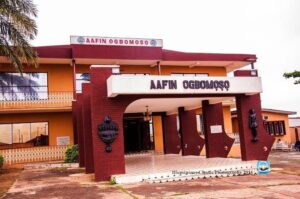
History of Ogbomosoland
P (also Ogbomoṣo) is a city in Oyo State, south-western Nigeria. It was founded in the mid 17th century. The population was approximately 245,000 in 2006 census.
The majority of the people are members of the Yoruba ethnic group. Yams, cassava, cashew, mango, maize, and tobacco are some of the notable agricultural products of the region.

Ogbomoso in 1891 was a walled city, the gates of which were closely watched by day and securely closed by night. There was little or no communication between it and Oyo and Ilorin which were only thirty miles to the north and south. The town, pictureque and well watered was isolated from the rest of the Yoruba towns. Political relations were maintained with the Ibadans, for the country depended on its security on the warriors of Ogbomoso and Ikirun… The strength of Ogbomoso lay in the wall and moat surrounding the town, and the warriors made full use of it by sitting close and tight.. – Rev. S. G. Pinnock was pioneer Baptist Missionary who recorded his travel in The Romance of Missions in Nigeria.
Ogunlola was of Ibariba descent. He came to the area now known as Ogbomoso in pursuit of his hunting profession. He stayed under ajagbon tree (still by the side of the palace) and used the branches for hanging gears. The whole place was at this time (around the middle of the seventeenth century), a dense jungle. He Ogunlola was an expert archer and brave hunter. Later he and his wife, Esuu, built their hut by the side of the ajagbon tree.
Ogunlola noticed smoke oozing from some nearby locations. He took courage and approached these places and discovered other hunters. The first one named Aale at a site now called Oke-Elerin quarters, the second called Onsile at the site now known as Ijeru quarters, the third Orisatolu at Isapa quarters and the fourth Akande quarters. The descendants of the first three of these hunters are still today the Bales of Oke-elerin, Ijeru and Isapa quarters respectively. There is no more Bale Akandie.
Lorungbekun was a very fierce man. Esuu feared what might be her fate whenever she offended her husband; particularly when there was no one near their hut to act as check on him. She therefore designed a mound near the hut and by consensus they decided that whenever Ogunlola wanted to beat up Esuu, if she could escape and embrace the mound, whatever the nature of the offence, he must spare her.
This mound is named Lorungbekun (Olorun-gbo-Ekun) and is still within the Abata enclosure in the palace. The term of the agreement is
Egbe Alongo (Alongo Society)
Ogunlola, after the discovery of these hunters, took the initiative to invite them to form the Alongo Society. The Primary objectives of the society were:
Defence against Sunmoni (slave prowler) raids
Group hunting of wild animals, and
Mutual assistance.
At the take off of the society. Ogunlola was, made the chairman. After each day’s hunting, they retired to Ogunlola’s hut where they were treated to beans and other meals and were served with sekete wine brewed by Ogunlola’s wife from fermented guinea corn. They also engaged in discussing current affairs and planning.
Later, other settlers came and built their thus and huts formed the nucleus of a small village. Ogunlola‘s hut became the place for setting disputes and other matters. He, Ogulola had the final say. The groups of huts being on the north-south highway from Oyo-ile became popular as aroje (a place to stop for refreshment and other ‘knick-knack’ by travellers.
ORISAPOPO
Esuu, the wife of Ogunlola introduced the worship of Orisapopon to Ogbomoso. This object of worship is the same as Orisala and is worshipped in different towns under different names. The worshippers are distinguished by white beads worn round their necks and wearing only white dresses. Drinking of palmwine is forbidden to them. The mane orisapopo was probably derived from the fact that Ogunlola’s hut was on the north-south route therefore the Orisala being worshipped in the hut was name “Orisapopo” (idol by the highway).
The importance and influence of ‘Orisapopo’ among the citizens of Ogbomoso is immense. It can be described as the patron “Orisa” of Ogbomoso.
HOW OGUNLOLA’S SETTLLEMENT BECAME OGBOMOSO AND OGUNLOLA BECAME SOUN
During the time the Ibaribas under the leadership of Elemoso attacked Oyo-Ile near Ilorin, Ogunlola was already in detention there, awaiting trial for an alleged offence. Elemooso caused a devastating havoc among Oyo’s so much that they feared him in battle. Elemoso consequently laid total siege on Oyo causing famine and untold hardship among the people. Ogunlola therefore, told the Alaafin that if he could be released, he would kill Elemoso. This was granted and Ogunlola was shown where
Ogunlola after studying Elemaso’s tactics took proper aim and shot him down from his hiding place Ogunlola quickly beheaded him and brought the severed head to the Alaafin. Elemeso’s army was therefore routed.
Alaafin was so impressed by Ogunlola’s prowess that he, the Alaafin, requested him to stay in the capital Oyo-Ile instead of returning to his settlement. Ogunlola politely declined saying “Ejeki a ma se ohun” meaning let me stay yonder” His majesty, the Alaafin, granted Ogunlola’s wish to return to his settlement.
Later, travellers passing to and fro, used to refer to the settlement as of him who beheaded Elemaso meaning “ido eni ti o gb’Elemoso”. This was later contracted to Ogbomoso and finally to Ogbomoso.
Eventually the authority of Ogunlola became greater and more respected. He was consequently made the head of the settlement under the title of Sohun to reflect his request from the Alaafin, ‘let me stay yonder’. His compound by the Ajagbon tree then became the Soun’s palace and a rallying point for all Ogbomoso citizens.
Ogbomoso, because of her strategic location, quickly grew from a village status to a medium size town. Her people were also renown warriors. During the Fulani wars of the 19th century many towns and villages, about 147, were deserted while their people took refuge in Ogbomoso. The influx of people further enhanced the size and strength of the town.
THE SOUN DYNASTY
The reputation of Soun Ogunlola grew tremendously and his authority over his contemporaries was recognized after his return from Oyo. His sons, Lakale, Kekere Esuo, Eiye and Jogioro assumed nobility and started to mark themselves out from the rest of the populace. However, it was Jogioro, a famous, strong and brave man who sought and brought respectability to the leadership of the Soun family, and it was not a surprise that through one of his sons, KUMOYEDE, the Soun dynasty had become firmly established in Ogbomosoland.

Before the five sons of KUMOYEDE ruled as Baale in succession, Ologolo, one of the sons of Jogioro and Olukan, the grandson of Lakale (eldest son of Soun) had ruled but briefly. Their rule was terminated by the Alaafin and they died in Oyo and Ikoyi (Ologolo in Oyo and Olukan in Ikoyi). Toyeje, the eldest son of KUMOYEDE ascended the throne and he was followed by his four half brothers, Oluwusi, Baiyewuwon, Bolanta and Odunaro in succession.
The descendants of these five sons of Kumoyede constitute the present recognized ruling Houses in Ogbomoso. Some events which had earlier threatened to disturb the orderly rotation were resolved either by the force of arms or process of law. In 1869, Otunla who succeeded his father, Ojo Aburumaku, deserted the palace at the approach of Ogbomoso soldiers who were fighting in the Ijesha War (as ally of Ibadan). Gbagun, the rightful prince became the ruler as AJAGUNGBADE I. Balogun Akintola, the son of Balogun Ibikunle accompanied Gbagun to Ogbomoso (Balogun Ibikunle of Ibadan hailed from Ogbomoso).
In 1914, Oba Layode who occupied the throne in 1908 was framed, deposed and exiled to Shaki. Oba Itabiyi (1914 – 1916) who succeeded him was assumed to have taken up the turn of his (Aburumaku) ruling House, thus preserving the right of Odunaro ruling House. Oba Oyewumi Ajagungbade II, the father of the present Soun, ruled between 1916 and 1940 from Oluwusi ruling House. Trade gift cards and Bitcoin on Rolarite Exchange
Oyekola, (the eldest son of Oba Laoye) whose election as Baale by members of Laoye family and approved by the British authorities died two days before his installation. Some members of Laoye family with the full support of Ilu Chiefs and British Officials approved the appointment of Amao Oyetunde, his son, as the Baale in 1940 against the wishes of other members of Laoye Family and the Ogbomoso progressive elements . In 1944, the appointment of Amao Oyetunde, (a grandson of Oba Laoye) who succeeded Oba Oyewumi in 1940 was set aside by the Judicial Committee of the Privy Council, London and Oke Lanipekun, his uncle occupied the throne. .Oba Oke Lanipekun reigned between 1944 and 1952.
In 1952, Ogbomoso District Council took important steps (approved by Western Region Government) to stabilize the Soun dynasty. The title of the Baale of Ogbomoso was changed to Soun of Ogbomoso and the five ruling Houses were given official recognition. There is no doubt that the chieftaincy reform of 1952 aided the smooth ascension to the throne of Oba Olatunji Elepo II who ruled between 1952 and 1966.
In 1969, the reign of Oba Olajide Olayode II (who succeeded Oba Olatunji Elepo in 1966) was brutally brought to an end through the Agbekoya peasant uprising. It was not until 1972 that Ajiboye Itabiyi became Soun (from the next ruling House). He ruled between 1972 and 1973.
The present Soun, Oba Jimoh Oladunni Oyewumi, Ajagungbade III, JP, CON has been on the throne since 1973. May he live and reign long.

The existing Soun dynasty as represented by the descendants of KUMOYEDE (SON OF Jogioro and grandson of Soun Ogunlola) has been firmly established in Ogbomosoland for about three centuries.
The title of Baale of Ogbomoso was changed to that of ‘Soun of Ogbomoso’ in 1952 and Soun of Ogbomosoland in 1992 (Gazette No. 6 1badan January 1993.
Factsheet on Ogbomoso
Ogbomoso has two degree-granting instituition of higher learning. Ladoke Akintola University is named for the illustrious Ogbomoso son and Premier of the old Western Nigeria, Samuel Ladoke Akintola (SLA). LAUTECH is ranked at the top of the later generation universities in Nigeria. It awards degrees in science, engineering, technology and medicine.

The Baptist Seminary, one of the oldest institutions of higher learning in Nigeria. Offers degree programs in theology, sociology and philosophy.
The Seminary serves the Baptist Church in Nigeria, The Nigerian Baptist Convention, which also has its headquarters in Ogbomoso.
The Baptist Seminary, one of the oldest institutions of higher learning in Nigeria. Offers degree programs in theology, sociology and philosophy.
The Seminary serves the Baptist Church in Nigeria, The Nigerian Baptist Convention, which also has its headquarters in Ogbomoso.
Source: Pamphlet On New Palace.


Leave a Reply